Hey Teacher Friend!
You have years of experience behind you. You have the degrees, the certifications and the hours of professional development. You’ve changed lesson plans in the middle of class because something wasn’t right and you knew it.
You know how to teach.
So why does your classroom feel off and why is student behavior such an issue?
That’s the question I sit with a lot these days — not as a researcher looking in from the outside, but as a teacher who is still in the classroom every single week. And what I’m watching in students’ nervous systems, behavior patterns, and emotional responses right now is genuinely different from what I was seeing even five years ago.
The reason classroom management feels harder isn’t because you’ve lost your edge. It’s because your students have changed — and nobody told you, retrained you, or handed you anything new to work with.

Why Classroom Management Feels Different for Experienced Teachers Right Now
There’s a particular kind of exhaustion that seasoned teachers carry. It’s not the tired-from-a-long-day kind. It’s the tired-from-trying-everything-and-nothing-sticking kind.
If that sounds familiar, I want to offer you three things I’m actively watching in today’s students — things that explain why the tools that used to work aren’t working the same way anymore.
Seasoned Teachers are
exhausted.
1. The Emotional Regulation Gap Is Real — and It’s New
The students sitting in front of you right now are struggling with emotional regulation in a way that is measurable and new. I see it every week in my own classroom:
- Students who cannot transition from one activity to the next without their nervous systems going into high alert
- Kids who read a minor social interaction — a bump in the hallway, a slightly sharper tone — as a genuine threat
- Students who shut down completely the moment the work gets hard
These are not discipline problems. They are regulation problems. And the critical difference is this: when you redirect a dysregulated student, apply a consequence, or send them to the hallway, you are treating a regulation problem like a compliance problem. That’s why it keeps not working. The tool is wrong for the job.

2. Belonging Needs Are More Urgent Than Ever
Students who don’t feel like they belong somewhere don’t behave like they belong somewhere. That has always been true. What’s changed is that the conditions that used to build belonging naturally — stable home environments, consistent community, secure relationships — are less reliable for more students than they’ve ever been.
As a result, you are being asked to do something nobody explicitly trained you for: build the belonging that some students are arriving without.
Belonging isn’t something you manage. It’s something you build — intentionally, specifically, with a framework underneath it. Not just good intentions and a warm bulletin board.

3. The Classroom You Were Trained to Teach In Doesn’t Exist Anymore
Here’s the one that I really want you to sit with.
The strategies you were trained on were designed for a different emotional landscape. They’re not failing because you’re failing. They’re failing because they were never built for the students sitting in front of you right now. Think of it this way: you were trained to drive a specific road. You got really good at it. And then — gradually, without anyone announcing it — the road changed. The surface is different. The conditions are different. And you’ve been white-knuckling it, telling yourself you just need to drive better.
But it was never about driving better. It was about recognizing that your skills aren’t outdated. Your tools are. And tools can be updated.
The Answer Isn’t More Strategies
Here’s what I’ve come to believe after 27 years in the classroom: the answer isn’t finding another strategy to layer on top of the ones that aren’t working.
It’s going back to the core of what has always worked in education — real relationships, real belonging, real creative engagement — and building a framework around it that actually holds for today’s students.
A framework that connects everything instead of leaving you with a pile of disconnected techniques that each work for a week and then fall apart.
That is what a RESET is. Not a restart. A return.
A Practical Place to Start
Before you redirect the next hard moment — pause and ask yourself one question: Is this a discipline problem, or is this a belonging problem?
Because when a student is dysregulated, disconnected, or disengaged, what they often need first isn’t a consequence. They need to feel seen. That shift in perspective — from how do I stop this behavior? to what is this behavior trying to tell me? — is where everything starts to change.
You Haven’t Changed. Your Students Have.
The teacher who stayed late, rewrote the lesson plan, and reached the kid in the back row — she is still in there. She hasn’t gone anywhere. She’s just been running on terrain that the old map wasn’t built for, without anyone handing her a new one.
That’s not a reflection of who you are as a teacher. It’s a solvable problem. And you are exactly the right person to solve it — because you have something a first-year teacher simply doesn’t have: years of instinct, relationship, and pattern recognition living inside you.
What you need now is a framework that puts all of that to work.

Is It Time for a Full Classroom RESET?
If you’re nodding along to everything in this post — if you recognize the exhaustion, the strategies that won’t stick, and the gap between the teacher you are and the classroom you’ve been managing — then you’re ready for more than a roadmap. You’re ready for a RESET.
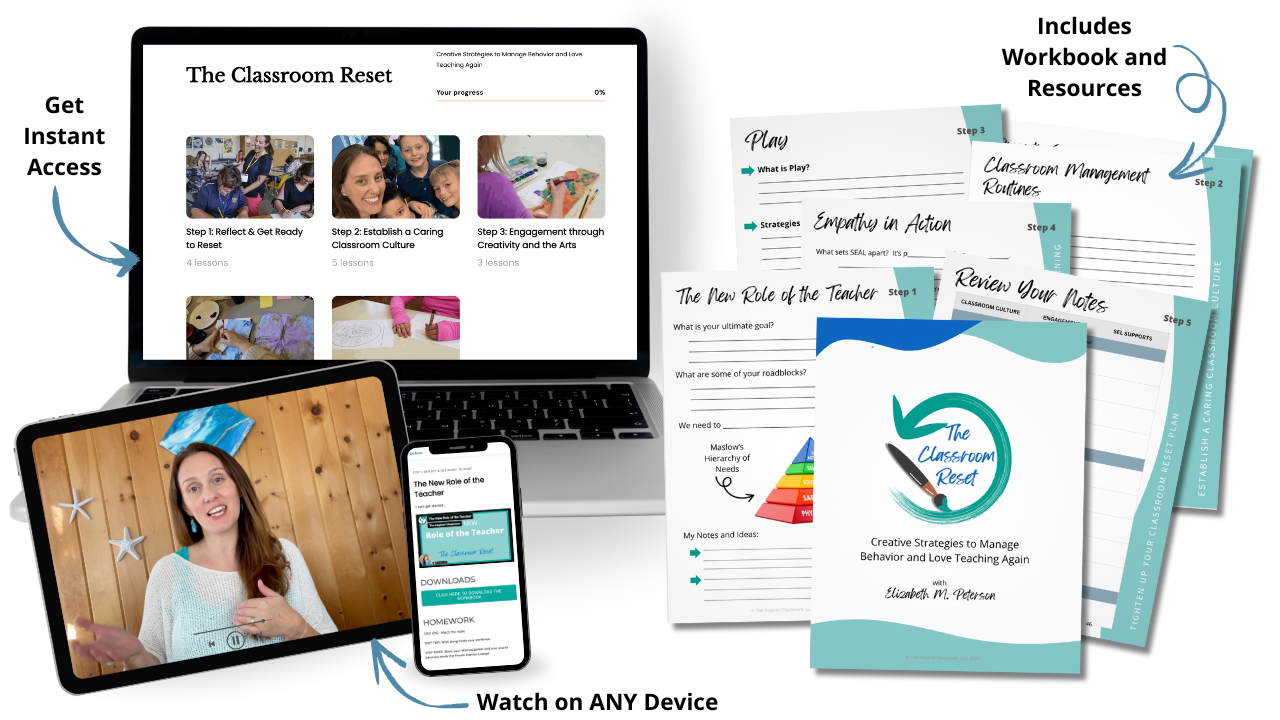
The Classroom RESET is my signature built around the five-step RESET Framework. It’s designed specifically for experienced teachers who are done white-knuckling it through the year and ready to build a classroom that actually feels like them again — calm, connected, and creative. Inside, you’ll get video trainings, monthly live coaching, a private teacher community, and personalized support from me. Not another course to collect dust. A real guided experience built around the classroom you’re actually in right now.
Because your skills aren’t outdated. Your tools are. And it’s time to update them.
Get in on the Experience!
The Classroom Reset
The Classroom Reset is your fresh (RE)start—designed to bring calm, connection, and creativity back to your classroom in just 6 weeks!
This teacher-centered RESET course is designed to help you improve student behavior and take care of your own well-being—without adding more to your plate. Through the proven RESET Framework, you’ll rebuild classroom culture, re-engage students through creative strategies, and strengthen SEL so that teaching feels calm, connected and joyful again! With Personalized 1:1 Support and a group of fellow educators walking alongside you—you’ll finally feel confident, calm, and in control again. This isn’t just another training. It’s a true RESET Experience: for your students, your classroom and YOU.