Hey Teacher Friend!
Does your classroom feel out of control?
Maybe some weeks feel like a gentle breeze.
And then other weeks feel more like tornado season.

If your classroom has started to feel chaotic week after week—constant reminders, frequent behavior interruptions, and students who seem to forget expectations—you are not alone. Many elementary teachers tell me they feel like they’re constantly putting out fires instead of teaching.
Even more frustrating? It can feel like things get better for a few days… and then the chaos comes right back.
So what’s really going on?
Let’s talk about why classrooms sometimes feel out of control every week, and what you can do to begin calming the storm.
When Classroom Chaos Keeps Coming Back
When behavior struggles continue for weeks or even months, it’s easy to assume the cause is something outside your control.
You might find yourself thinking:
-
It’s this group of students
-
It’s the time of year
-
It’s testing season
-
It’s lack of support from home
-
It’s just the personalities in this class
And yes, those factors can absolutely make teaching harder.
However, after working with hundreds of teachers and reflecting on my own classroom experience, I’ve noticed something important.
Often the real issue isn’t just behavior.
Instead, the classroom may be missing something deeper: a stable classroom culture anchor.
Without that foundation, behavior challenges can keep regenerating, even when teachers try new strategies or consequences.

The Difference Between Managing Behavior and Building Classroom Culture
Most teachers have been trained to manage behavior.
As a result, when classrooms feel chaotic, we often respond by tightening control. We might try:
-
More reminders
-
Behavior charts
-
Taking away recess
-
Calling or emailing home
-
Starting a new reward system
Sometimes those strategies help in the moment. But unfortunately, they often treat the symptoms instead of the root issue.
Students may comply for a day or two, yet the overall classroom atmosphere doesn’t truly change.
That’s because lasting calm doesn’t come from control alone.
Instead, it grows from shared expectations, belonging, and classroom identity.
In other words, classroom culture matters just as much as classroom management.
Calm
comes from:
shared expectations,
belonging, and
classroom identity.
…
Culture!
Why Classroom Culture Helps Prevent Behavior Problems
When students feel connected to their classroom community, they are far more likely to regulate their behavior and support one another.
A strong classroom culture helps students understand:
-
Who we are as a class
-
How we treat each other
-
What it feels like to belong in this space
Without that shared understanding, behavior expectations can feel inconsistent or temporary.
However, when culture is intentionally built and reinforced, the entire classroom environment begins to shift.
Students start holding themselves—and each other—accountable.
That’s when teaching begins to feel calmer again.

A Simple Classroom Micro-Reset
If your classroom currently feels stuck in storm mode, sometimes a small reset can help shift the atmosphere.
Instead of launching an entirely new behavior system, consider pausing and reconnecting with your students.
Here are a few simple ideas that can help:
1. Re-establish expectations clearly
Take a few minutes to gather students together and revisit classroom expectations. A quick class meeting can help everyone pause and refocus.
2. Create a short-term class goal
Students often respond well to something positive to work toward. Even a simple daily goal can rebuild momentum.
3. Build a shared classroom moment
Connection strengthens classroom culture. Try something quick and engaging such as:
-
A creative drawing prompt
-
A short teamwork challenge
-
A quick arts-based brain break
These experiences remind students that they are part of a community, not just individuals in a room.
4. Reinforce classroom identity
Language matters more than we realize. Phrases like:
“We are the kind of class who helps each other.”
or
“We are the kind of class who can reset when things get off track.”
…can begin to shape how students see themselves as a group.
5. Reflect together
Finally, take a moment at the end of the day or week to reflect. Ask students what felt different and what helped the classroom feel calmer.
Reflection helps new habits stick.

When You Need a Bigger Classroom Reset
While a quick reset can help stabilize things in the short term, sometimes teachers need something deeper.
A classroom reset isn’t about adding more programs or complicated systems. Instead, it’s about intentionally rebuilding the foundation of classroom culture so behavior problems stop repeating week after week.
When teachers focus on culture, connection, and social-emotional learning alongside expectations, the classroom begins to feel calmer and more supportive for everyone.
And that’s when teaching becomes joyful again.
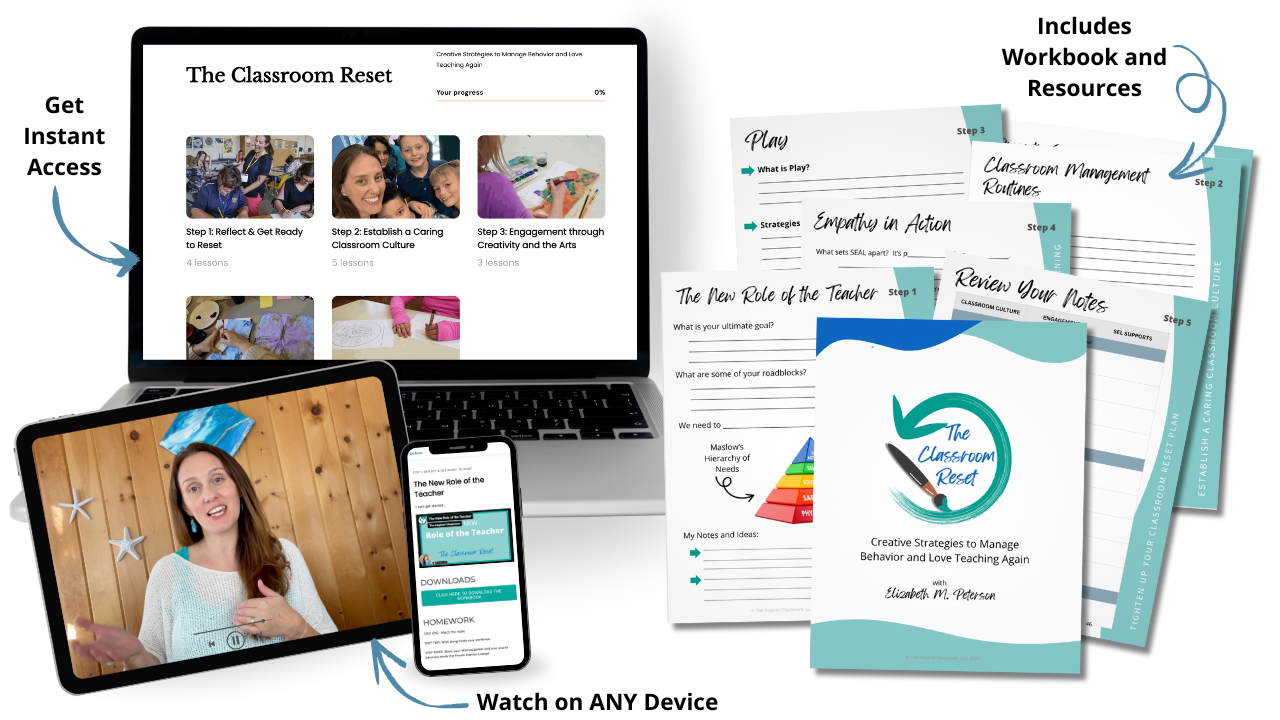
>> The Classroom Reset
The Classroom Reset is your fresh (RE)start—designed to bring calm, connection, and creativity back to your classroom in just 6 weeks!
This teacher-centered RESET experience is designed to help you improve student behavior and take care of your own well-being—without adding more to your plate. Through the proven RESET Framework, you’ll rebuild classroom culture, reengage students through creative strategies, and strengthen SEL so that teaching feels calm, connected and joyful again! With Personalized 1:1 Support and a group of fellow educators walking alongside you—you’ll finally feel confident, calm, and in control again. This isn’t just another training. It’s a true RESET Experience: for your students, your classroom and YOU.
A Final Encouragement
Teaching during difficult classroom seasons can feel exhausting. Yet even small shifts in classroom culture can make a powerful difference.
You don’t have to fix everything all at once. Sometimes it simply starts with a pause, a conversation, and a shared reset.
You’re doing important work, and your effort to create a caring classroom truly matters.
I hope this inspired you today.
And if you’d like to hear the full conversation and strategies, be sure to listen to the podcast episode as well.
I hope this inspired you today.

Get in on the Experience!
The Classroom Reset
The Classroom Reset is your fresh (RE)start—designed to bring calm, connection, and creativity back to your classroom in just 6 weeks!
This teacher-centered RESET course is designed to help you improve student behavior and take care of your own well-being—without adding more to your plate. Through the proven RESET Framework, you’ll rebuild classroom culture, re-engage students through creative strategies, and strengthen SEL so that teaching feels calm, connected and joyful again! With Personalized 1:1 Support and a group of fellow educators walking alongside you—you’ll finally feel confident, calm, and in control again. This isn’t just another training. It’s a true RESET Experience: for your students, your classroom and YOU.