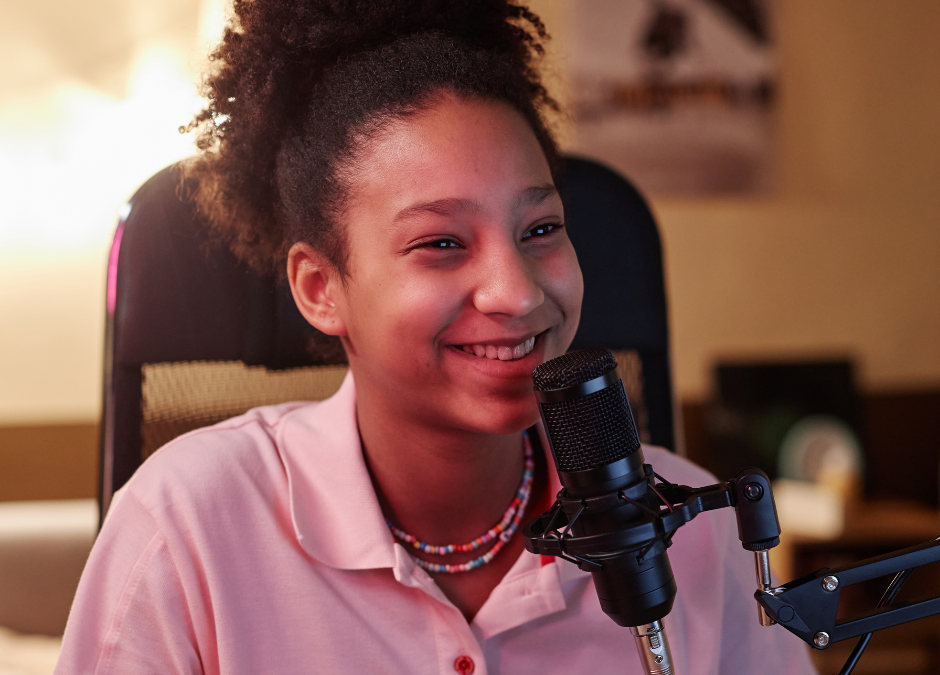
As screens become more prominent in classrooms, podcasting offers an audio-based option that calls on imaginative and mental modeling skills. Without visuals to lean on, students build their own images using creativity, comprehension, and their understanding of lesson material. Podcast host Guy Raz calls the blank canvas of an audio project the “theater of the mind,” where students build their worlds through words. At a time when schools wrestle with attention drift and device fatigue, the microphone can restore focus and provide a refreshing change from traditional methods of assessing understanding.
Why Podcasting Works for Student Learning
When students create podcasts, they engage in auditory learning and review lesson content. Producing podcasts requires students to think deeply about their subject, driving independent research and the connection of new and prior knowledge, as shown by a study published by the Association for Learning Technology. The podcast idea also mirrors some benefits of the flipped‐classroom model, as students take ownership of their learning and investigate outside of class for their topic.
Recording asks students to verbalize their thinking. When learners explain ideas aloud, they can uncover gaps in their knowledge, even if they may seem to understand it on the surface. Overt verbalization—in this case, explaining the concept to others—helps students articulate and retain what they’ve learned. Instead of passively consuming content, students act as creators who dive into curriculum content through audio narration. Plus, it teaches them valuable communication and presentation skills, including summarizing key points for listeners, developing a coherent narrative, and painting clear visuals.
Tech & Tools for a Simple, Student‐Friendly Setup
Creating a classroom podcast doesn’t require expensive gear. Most smartphones have built-in recording apps, such as the Voice Memos on iPhones, which offer crisp recording for speech. Plus, these are easy to use and have extensive online support in the form of tutorials, communities, and sample projects. The goal is simplicity: if technology is straightforward, students focus on content rather than tech hurdles.
Integration into Curriculum
Podcasts can enrich every subject area with authentic student work. In math, students might record themselves explaining problem‐solving steps, which requires them to work through their reasoning and rehearse in a way others can follow. In science, a “lab report” podcast invites students to summarize experiments and reflect on outcomes. Social studies lends itself to episodic “history news” segments where students report on key events, building research and
narrative structuring skills. Different relationships, such as cause-and-effect or compare-and-contrast, can be explored in each podcast.
Possible Lesson Structure & Reflection
A simple framework—plan, record, publish, peer‐review, reflect—can help students through the creative process. In the planning phase, they choose a topic, outline their message, and script a rough draft. The recording stage follows, where students challenge themselves to practice clarity and pacing. Once produced, students can listen to their peers’ podcasts and see how others tackled the prompt. A reflection component can follow, asking them to focus on what information they decided to include in their podcast and what thought went into creating it.
Tips to Get Started & Overcome Challenges
Limiting episodes to a few minutes keeps projects manageable. These bite‐sized productions fit within project‐based learning structures and avoid overwhelming both students and teachers, who can use them for graded assignments.
Providing criteria can work to balance student voice with academic rigor. For example, placing content accuracy, use of academic language, effective structure, and engaging audio quality as possible requirements can promote these skills and make for well-written and informative podcasts. Encouraging students to take responsibility for content accuracy by verifying sources before recording can help them practice a vital skill grounded in digital media literacy and ethical media creation.
Conclusion
Involving students in podcast creation blends public speaking, research, reflection, and creativity. This learning experience, which results in concrete products with real audiences, builds 21st‐century skills and mirrors project‐based learning practices.
As a learning tool, classroom podcasting can be applied across subjects and assist students in owning their understanding. With minimal technical investment, it is easy to implement this approach and amplify student voice through an activity that gives them a new take on lesson content.
Author bio:
Hello! I’m Alisha Jain (ajs-takes.org), an education enthusiast, blogger, and the author of Partnered Problem Solving: Anecdotal Insights and Practical Strategies for Collaboration in Math Classrooms. I have mainly worked with students one-on-one, which sparked my interest in STEAM education and conceptual learning. My goal is to break down fixed mindsets and promote the understanding of mathematical concepts in relation to one another. There are many harmful stigmas around who is a “math person” and who isn’t, which is something I hope to remedy with accessible and interesting lesson plans.